Most products compromise on performance, safety, or durability. VaporLock doesn’t.
Two Types - Neither Perfect
Until Now.
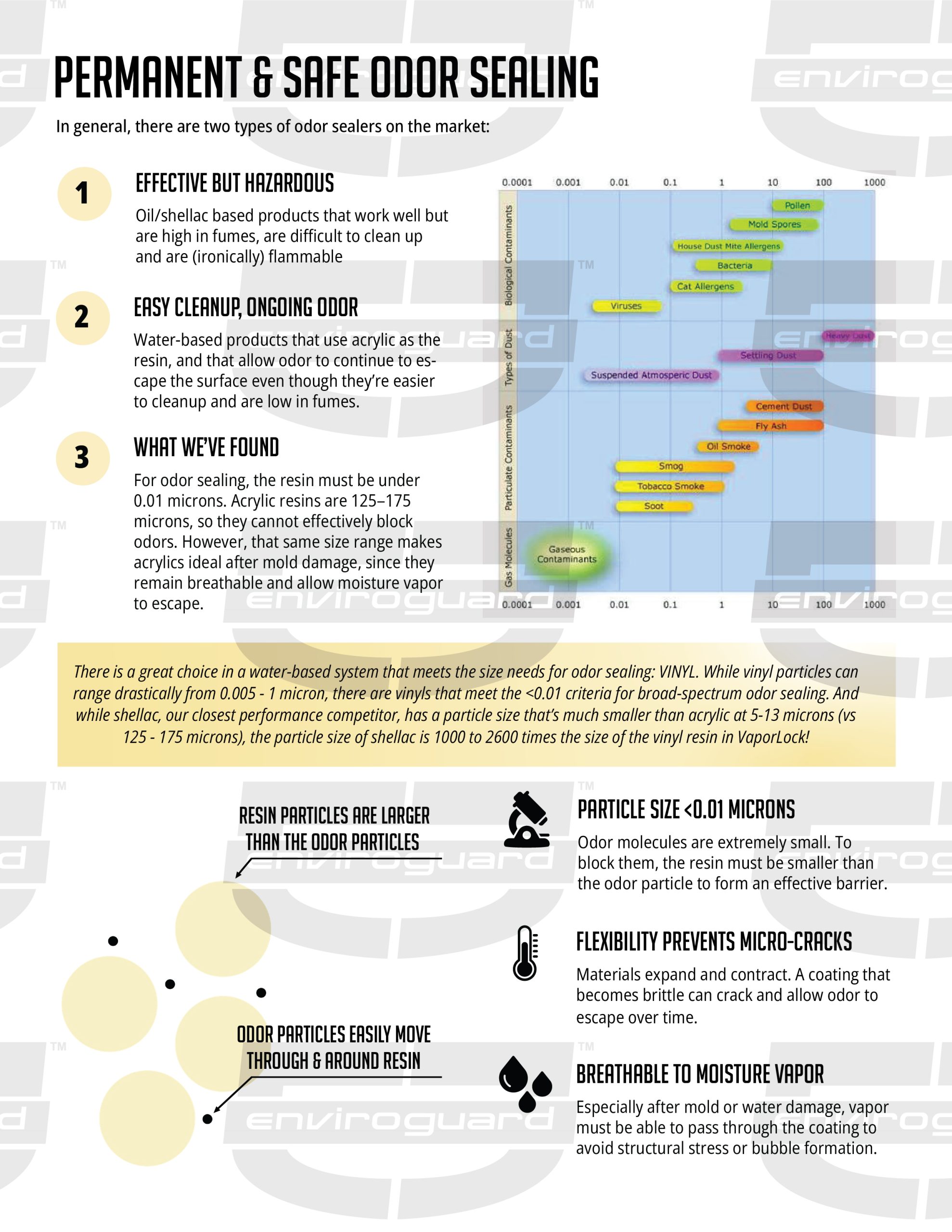
In general, there are two types of odor sealers on the market:
Oil / Shellac
Work well but are high in fumes, difficult to clean up, and flammable.
Water-Based (Acrylic)
Easier to clean up and low in fumes, but allow odor to continue escaping the surface.
Years ago we did work in the area of micro-emulsions for industrial use. Micro-emulsions are sealants where the resin component is developed with a molecular size smaller than the particle it is blocking. For odor blocking, that means selecting a resin where the particle size is less than 0.01 microns.
Since acrylic ranges between 125–175 microns, it’s obviously not the right choice for odor sealing. (That same large particle size is actually why acrylics are great for coating after mold damage — at 125–175 microns they provide a breathable solution for moisture vapor release.)
The Science Behind VaporLock: Particle Size Matters
There is a great water-based choice that meets the size requirement for odor sealing: VINYL. While vinyl particles can range from 0.005–1 micron, there are vinyls that meet the <0.01 micron criteria for broad-spectrum odor sealing.
<0.01 µm
VaporLock vinyl resin particle size
5–13 µm
Shellac particle size
125–175 µm
Acrylic particle size
Shellac — our closest performance competitor — has a particle size of 5–13 microns. That’s already far better than acrylic, but the vinyl resin in VaporLock is 1,000 to 2,600 times smaller than shellac.
Particle size is the most important factor in odor sealing, but maintaining a flexible coating surface that can elongate as temperatures rise and surfaces expand is also essential for long-term performance. This is where shellac products have a second problem: they are very hard and very brittle. Over time, hairline fractures form in the coating, exposing the surface and allowing odor to escape.
VaporLock products are formulated with plasticizers to prevent this, assuring long-term durability and performance.
Fire Events are Generally also Water Events.
Because water is commonly used to extinguish fire, secondary damage frequently results. It’s not uncommon for a fire loss to require S-500 water damage emergency restoration measures and, in many cases, S-520 measures for mold remediation.
With that in mind, VaporLock products are formulated with the same EPA-registered, marine-grade antimicrobial found in products like MaxGuard and SafeGuard — an extra measure of performance that minimizes problems during reconstruction or in unconditioned areas like basements, crawl spaces, and attics.
Safe + Easy to Use
Unlike oil and shellac-based products, VaporLock cleans up easily with soap and water and is completely fume-free, making it a pleasure to work with.
VaporLock is available in both Clear and White formulas:
Clear — ideal for surfaces that will remain visible (attics, exposed framing) or to salvage odor-damaged painted surfaces by top-coating instead of priming and re-painting.
White — ideal for covering staining or priming while odor sealing simultaneously. Tintable for color matching.
VaporLock handles the full spectrum of odor sources:
SmokeCookingPetNicotineInfestationDecompositionAnd more
Featured Products
VaporLock
Broad-spectrum odor sealing in Clear and White. Water-based, non-flammable, and formaldehyde-free.