May's newsletter is out! ✉️

FOR RESTORATION OWNERS

Rotten Egg, Ammonia, or Sweet?
What Sewage Odor Reveals About the Source

Sewage odor isn’t one smell — it’s a chemical readout. Each note points to a different process, a different source, and a different fix. Learn to read it before you touch it.

JUNE 22, 2026  ·  ODOR REMEDIATION  ·  6 MIN READ

Let’s Set the Scene

You open the basement door and it hits you before your foot finds the stairs. But stop for a second — which smell is it? The homeowner says “it smells like sewage” and waves you toward the floor drain. They’re not wrong. They’re just not specific, and specificity is the whole job.

A sharp, rotten-egg bite means one thing. A heavy, clinging fecal note means another. A sweet-sour, fermented edge means a third — and the musty layer riding on top means the moisture has been sitting long enough for mold to move in. Each of those is a different molecule, made by a different process, from a different source. Spray a deodorizer over all four and you’ve treated none of them. The smell drops for a day, the homeowner relaxes, and you get the callback the following week.

Your nose is the first diagnostic instrument on the truck — and on a sewage loss it reads parts-per-billion before any meter you own. The trick is knowing what each note is telling you about what’s rotting, where it’s hiding, and how deep it’s gone. Read the smell first. Then Clean, Sanitize, and Control in that order.

The Smell Is Data

One Word, Many Molecules

“Sewage” is a category, not a compound. What you’re actually smelling is a cocktail of gases thrown off as bacteria digest the organic load in waste — and the mix shifts depending on what’s decomposing and how long it’s been at it. Learn the signatures and the odor becomes a map of the source.

What You SmellPrimary CompoundWhat’s HappeningWhat It Reveals
Rotten eggs HazardHydrogen sulfide (H₂S)Sulfate-reducing bacteria working anaerobicallyStanding, stagnant water and biofilm — the loss has been sitting. Also a toxic gas, not just an odor.
Sharp, pungent, cat-litterAmmonia (NH₃)Urea broken down by urease enzymesUrine-heavy, nitrogen-rich contamination — concentrated, not just diluted gray water.
Heavy fecal, barnyard PersistentIndole & skatoleGut bacteria breaking down tryptophan (protein)Actual fecal solids in the structure — deep, clinging, slow to clear. True Category 3.
Sour, rancid, cheesyVolatile fatty acids (butyric, valeric)Fermentation of fats and food wasteGrease-laden gray water — kitchen lines, floor drains, FOG buildup.
Musty, earthy SecondaryGeosmin & microbial VOCsMold colonizing wetted organic materialThe water sat too long — you now have a mold problem layered on the sewage problem.
⚠ Field Note

No visible source? The smell still tells you where to look.

If the odor is clear sewer gas — that rotten-egg H₂S note — with nothing wet in sight, you’re not looking at a spill. You’re looking at a pathway. The two usual suspects: a dry P-trap (an unused floor drain or fixture whose water seal evaporated, letting sewer gas climb straight up the line) or a venting fault letting the system breathe back into the room.

Read the pattern: an odor that’s intermittent and worse after fixtures sit unused points to a dry trap — prime it and watch. An odor that’s constant, localized, and strongest near porous materials points to absorbed contamination that wicked in and is now off-gassing from inside the substrate. Same “sewage smell,” opposite fixes.

The Chemistry Underneath

Why Sewage Smells — and Why It’s Dangerous

An odor is just a volatile molecule light enough to leave a surface and reach a receptor in your nose. Sewage is a volatile factory because decomposition is metabolism: bacteria strip electrons from organic matter and exhale the byproducts as gas. Cut off the oxygen — a flooded crawl space, a sealed line, water standing over a drain — and that metabolism turns anaerobic, which is where the worst-smelling and most dangerous compounds come from.

The headline gas is hydrogen sulfide. Sulfate-reducing bacteria (think Desulfovibrio) use sulfate as their oxygen substitute and excrete H₂S as the waste product — the same reaction that blackens stagnant water and corrodes the underside of concrete pipe. Meanwhile urease enzymes hydrolyze urea into ammonia and CO₂, and gut bacteria decarboxylate the amino acid tryptophan into indole and skatole — the molecules responsible for the unmistakable fecal note, detectable far below a part per million.

The Smell That Gets Quieter as It Gets Deadlier

Your nose catches hydrogen sulfide at around 0.5 parts per billion — an extraordinary detector. But H₂S has a trick that makes it genuinely dangerous on a job site: at high concentrations it paralyzes the olfactory nerve. Above roughly 100 ppm, the smell fades — not because the gas is gone, but because you’ve lost the ability to detect it.

That inverts the usual logic. On most jobs, “the smell got better” means progress. In an enclosed sewage space with poor ventilation, a sulfur smell that suddenly drops off can mean the concentration climbed into the danger zone. Never read a fading rotten-egg odor as good news in a confined space. Meter it, ventilate it, and treat H₂S as the toxic gas it is.

0.5
ppb Detection

Roughly the level at which a human nose registers hydrogen sulfide — far below most field instruments.

100
ppm Olfactory Loss

Around this concentration H₂S deadens your sense of smell — the odor fades while the hazard climbs.

Cat 3
Black Water

Sewage backups are grossly contaminated under IICRC S500 — pathogen-bearing, not just malodorous.

Common Failure Points

Why Sewage Jobs Come Back

Sewage callbacks aren’t bad luck. They trace to a handful of predictable mistakes — almost all of them a version of treating the smell instead of the source that’s making it.

  • Deodorizing over the organic load. Foggers and fragrances don’t remove the waste film, the biofilm, or the bacteria. They overwrite your nose for a day. The microbes keep eating and keep exhaling H₂S, ammonia, and skatole. Mask the readout and you’ve only hidden the problem from yourself.
  • Disinfecting before you clean. An oxidizer or sanitizer thrown at raw sewage gets consumed by the bulk organic soil before it ever reaches the bacteria or the odor compounds. You spend the whole dose on mud. Cleaning isn’t a nicety before sanitizing — it’s what makes sanitizing possible.
  • Surface-only treatment on porous materials. Black water wicks into drywall, subfloor, sill plate, and concrete. Wipe the surface and the reservoir below keeps off-gassing. Porous, saturated materials in a Category 3 loss usually come out — not get sprayed.
  • Leaving the bacteria alive. As long as live sulfate-reducing and proteolytic bacteria sit on a food source, the odor regenerates. Neutralizing today’s gas without killing what’s producing it just resets the clock. You have to break the cycle, not the current batch.
  • Ignoring voids and the deep substrate. Gas migrates into wall cavities, under flooring, and into the structural wood. Liquid can’t coat what it can’t reach — and residual contamination below the surface needs the gas phase to treat and a barrier to contain.
The Full System

Three Products. One Protocol That Actually Holds.

Whether it’s a single backed-up floor drain or a crawl space that took a Category 3 loss for a week, the system is the same. The dosing changes; the sequence doesn’t — Clean, Sanitize, Control.

PreClean 1 Gallon
Step 1 — Clean
PreClean

Concentrated pre-cleaning agent built to cut through the toughest soil loads on water, sewage, mold, fire, and bio-hazard jobs. It penetrates, lifts, and removes caked-on dirt, oils, greases, and soo

Shop Now ›
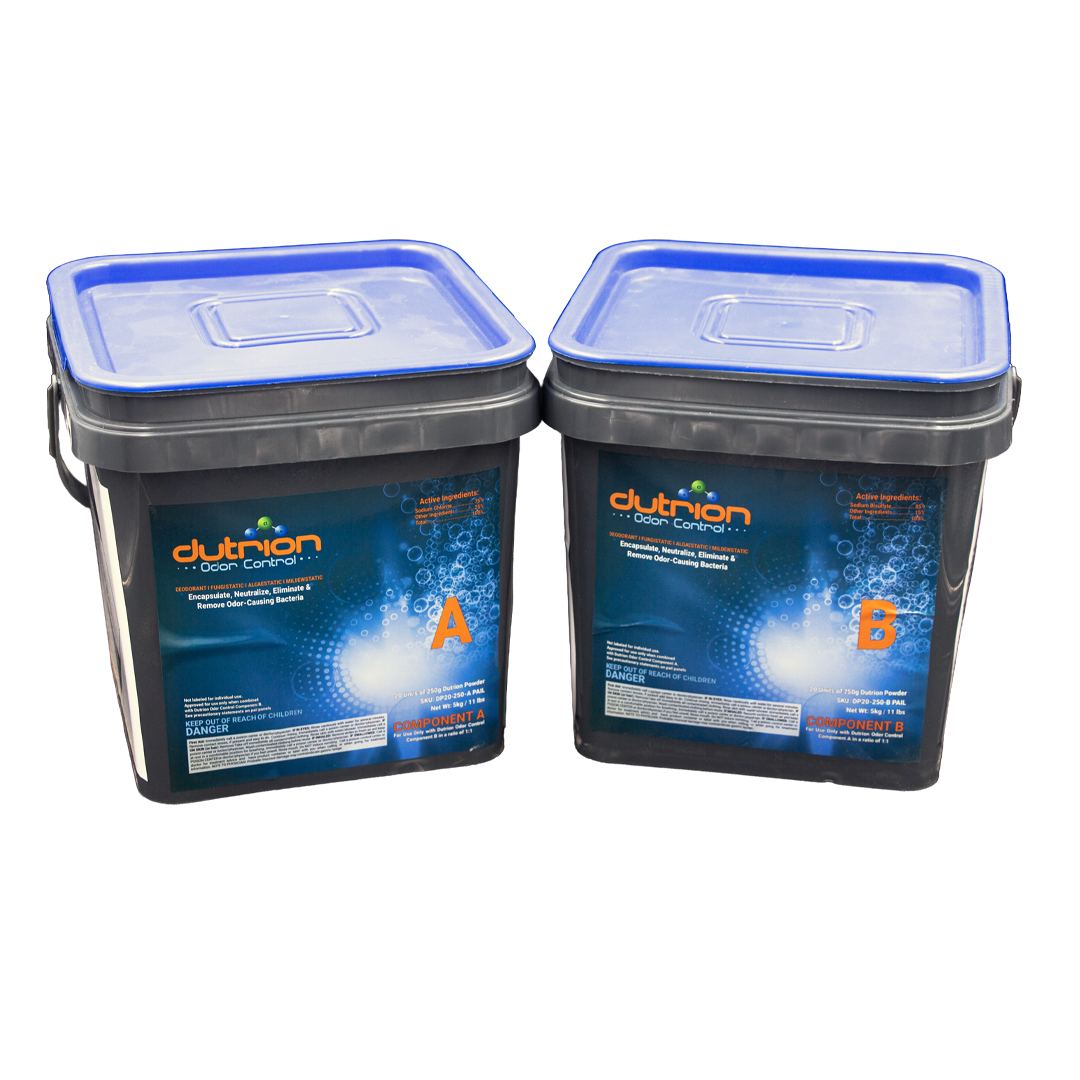
Dutrion Chlorine Dioxide Pail
Step 2 — Sanitize
Dutrion

Chlorine dioxide oxidizer in liquid and gas-phase formats. Converts H₂S to odorless sulfate, destroys fecal and sulfur compounds, and kills the bacteria producing them — in surfaces, ducts, and voids alike.

Shop Now ›
VaporLock Clear 5 Gallon
Step 3 — Control
VaporLock

Vapor-impermeable encapsulant that closes the re-emission pathway for good. Seals residual deep-substrate compounds in place so the next humid week doesn’t bring the sewage odor back.

Shop Now ›
The Takeaway

The Odor Is the Diagnosis. Treat It Like One.

Sewage odor beats people because they treat it as a single nuisance to cover up. It isn’t. It’s a chemical readout — rotten eggs for anaerobic sulfide and stagnant water, sharp ammonia for nitrogen-heavy urine, a clinging fecal note for real solids gone deep, a musty layer when the moisture sat long enough to grow mold. Read it, and you already know where the source is and how far it’s traveled.

From there the fix follows the chemistry: Clean away the organic load the bacteria feed on, Sanitize to oxidize the odor compounds and kill what’s making them, and Control the deep residual with a barrier so moisture can’t restart the cycle. That’s not a product pitch — it’s just what the molecules require.

Your nose found the problem before any meter did. Let it guide the work, and the smell doesn’t come back.

References
  1. Agency for Toxic Substances and Disease Registry (ATSDR). Toxicological Profile for Hydrogen Sulfide and Carbonyl Sulfide — odor thresholds, olfactory fatigue, and exposure limits. U.S. Department of Health & Human Services.
  2. Muyzer, G., & Stams, A. J. M. (2008). “The ecology and biotechnology of sulphate-reducing bacteria.” Nature Reviews Microbiology, 6(6), 441–454.
  3. U.S. EPA. Alternative Disinfectants and Oxidants Guidance Manual — Chlorine Dioxide. Office of Water (reaction chemistry, pH range, byproduct profile).
  4. IICRC. ANSI/IICRC S500 Standard for Professional Water Damage Restoration — Category 3 (grossly contaminated / “black water”) classification and handling.
  5. Mottram, D. S., & others. “Indole and skatole as products of tryptophan degradation by intestinal bacteria.” Reviews in food and microbial volatile chemistry (fecal odor characterization).
  6. Mobley, H. L. T., & Hausinger, R. P. (1989). “Microbial ureases: significance, regulation, and molecular characterization.” Microbiological Reviews, 53(1), 85–108 (urea hydrolysis to ammonia).
Share the Post: