4-log
≥ 99.99% spore reduction demonstrated on building materials


The Chemistry Behind Remediation
Chlorine dioxide ClO2 is a selective oxidant that inactivates mold, bacteria, viruses, mycotoxins and allergens — and destroys the odor compounds they leave behind. Below is what the science actually shows — and how the two Dutrion formats put that chemistry to work in the field.
Conventional cleaners move contamination around. Chlorine dioxide destroys it by electron transfer — pulling the structure apart at the cellular level rather than relying on contact friction. Three properties make it the workhorse oxidant for restoration.
ClO₂ reacts preferentially with the organic matter in spores, biofilm and odor molecules. It carries a low oxidation power but a high oxidation capacity — aggressive toward contamination, comparatively gentle on most surfaces and equipment.
Unlike chlorine, chlorine dioxide stays effective at low temperatures and across a wide pH range, and it does not shift the pH of what it touches. No chlorine smell, no salty residue — the chloride ion never enters the reaction.
As a true gas, ClO₂ penetrates porous materials, wall cavities, attics, ductwork and contents in place — the same property that let it remediate entire buildings after the 2001 anthrax response and heavily mold-contaminated structures since.
In a 2013 laboratory study, EPA's National Homeland Security Research Center fumigated common building materials — painted and wallpapered drywall, pine, ceiling tile, carpet and glass — contaminated with five mold species, plus pure allergen and mycotoxin. The reduction was scored as a log change: each "log" is a tenfold drop, so 4-log means 99.99% of viable spores gone.
Source: U.S. EPA, "Laboratory Evaluation of the Efficacy of Chlorine Dioxide Fumigation for Remediation of Building Materials Contaminated with Molds, Mycotoxins or Allergens," EPA/600/R-13-229, Nov 2013. The study evaluates high-CT gas-phase fumigation. EPA does not endorse any commercial product; figures describe the chemistry, not a Dutrion claim.
Killing live mold is the easy part. The lasting health complaints — and the failed clearances — usually trace to what mold leaves behind: heat-stable mycotoxins and protein allergens that survive long after the colony is dead. A wider body of peer-reviewed work, beyond the EPA report, shows where chlorine dioxide helps and where it has limits.
Mycotoxins are stable molecules that ordinary cleaning and even spore removal can leave intact. Chlorine dioxide degrades many of them directly by oxidation — though efficacy depends on the toxin, the dose and whether the toxin is shielded inside spore structures.
Allergens aren't alive, so they can't be "killed" — they're proteins and organic fragments from pollen, dander, dust-mite and cockroach debris, and broken mold spores. As a selective oxidant, ClO₂ chemically alters their structure so the immune system no longer recognizes them, and as a gas it reaches allergen reservoirs in HVAC, cavities and porous materials that wiping can't.
Read it straight: chlorine dioxide is one of the few field-deployable chemistries shown to lower both mycotoxin and allergen load — but results vary by toxin, dose and how shielded the target is. It reduces and denatures; it is not a guaranteed 100% on every compound, and it does not replace source removal and moisture control.
The same oxidation that ends mold also ends the bacteria, biofilm and volatile compounds driving most restoration odors. One chemistry covers an unusually wide slice of the job board.
Treats Category 2–3 microbial growth on structure and contents after extraction; halts mold colonization in the drying window.
Oxidizes embedded smoke and char odor compounds that masking agents only cover — at the molecular source, not the surface.
Inactivates spores, hyphae and the allergens/mycotoxins they shed across porous and non-porous materials alike.
Destroys odor-causing bacteria and VOCs rather than perfuming over them — leaving no residual fragrance to flag.
Broad-spectrum sanitizer/virucide for decontaminating affected surfaces during cleanup of sensitive scenes.
Lightweight, shelf-stable, mixed on site — sizes from a quart to large batches with no generator or power supply.
Knocks down compounded biological load and deeply set odor in heavily soiled, long-neglected interiors.
Targets the bacteria behind urine, decomposition and animal-intrusion odor in cavities a sprayer can't reach.
Most restoration disinfectants fall into one of three chemistries: an oxidizer like chlorine dioxide, a quaternary ammonium (quat) cationic surfactant, or a botanical thymol formula. All three are EPA-registered and all three have a place — but they behave very differently on the contaminated, organic-loaded, porous problems that define this trade. Here's the honest breakdown.
| Chlorine DioxideDutrion | Quaternary AmmoniumQuats / QAC | BotanicalThymol-based | |
|---|---|---|---|
| Mechanism | Selective oxidationElectron transfer hits multiple cell targets at once | SurfactantCationic charge disrupts the cell membrane | PhenolicThymol breaks down cell walls on contact |
| Sporicidal | YesKills mold & bacterial spores at proper CT | NoSporostatic at best — spore wall blocks it | NoNo sporicidal claim |
| Non-enveloped viruses | YesOxidizer; virucidal incl. Rotavirus-class | LimitedUnreliable on non-enveloped viruses | VariesBy specific product label |
| Performance in organic soil | Retains capacityHigh oxidation capacity works through load | InactivatedOrganic soil neutralizes quats | ReducedPre-cleaning still required |
| Hard-water tolerance | UnaffectedWorks across pH and at low temp | InactivatedHard water cuts efficacy sharply | TolerantGenerally unaffected |
| Residue & rinse | NoneNo film, no rinse | ClingsLeaves residue; can need rinsing | LowNo-rinse, biodegradable |
| Vapor / gas-phase reach | YesPenetrates cavities, HVAC, porous materials | NoLiquid only | Fog onlyDroplets don't penetrate like a true gas |
| Degrades mycotoxins | YesOxidizes the toxin molecule | NoNo toxin action | NoNo toxin action |
| Denatures allergens | YesOxidative protein denaturation | NoNo allergen claim | SomeCertain labels claim allergen reduction |
| Typical dwell time | 1 minVirucide at 400 ppm | ~10 minFor proper disinfection | 1–4 minBy organism |
| Resistance concern | LowMulti-target oxidation resists adaptation | DocumentedQAC-resistance genes reported | LowBotanical phenolic |
| Where it works | Surfaces + whole-spaceLiquid and vapor fumigation | Hard, non-porousSurface only | Hard, non-porousSurface only |
Botanicals earn their spot on low toxicity, no PPE and simplicity for routine surface disinfection — but they're surface-only and not sporicidal.
Quats are inexpensive and stable for general housekeeping — until organic soil, hard water or spores enter the picture, which is most of restoration.
Chlorine dioxide is the one chemistry that stays effective through organic load, kills spores, degrades toxins, and reaches what a sprayer can't as a vapor.
Comparison reflects documented class characteristics of each chemistry; specific EPA-registered label claims, concentrations and dwell times govern actual use of any product. Sources: CFSPH "Disinfection 101" (Iowa State); ScienceDirect / Taylor & Francis QAC overviews; CISA QAC alternatives fact sheet; manufacturer labels for thymol-based botanical disinfectants. EPA does not endorse any commercial product.
Same active chemistry, two delivery modes. The decision comes down to one question: are you treating surfaces you can reach with a sprayer, or are you treating a whole space — including everything porous and out of reach inside it?
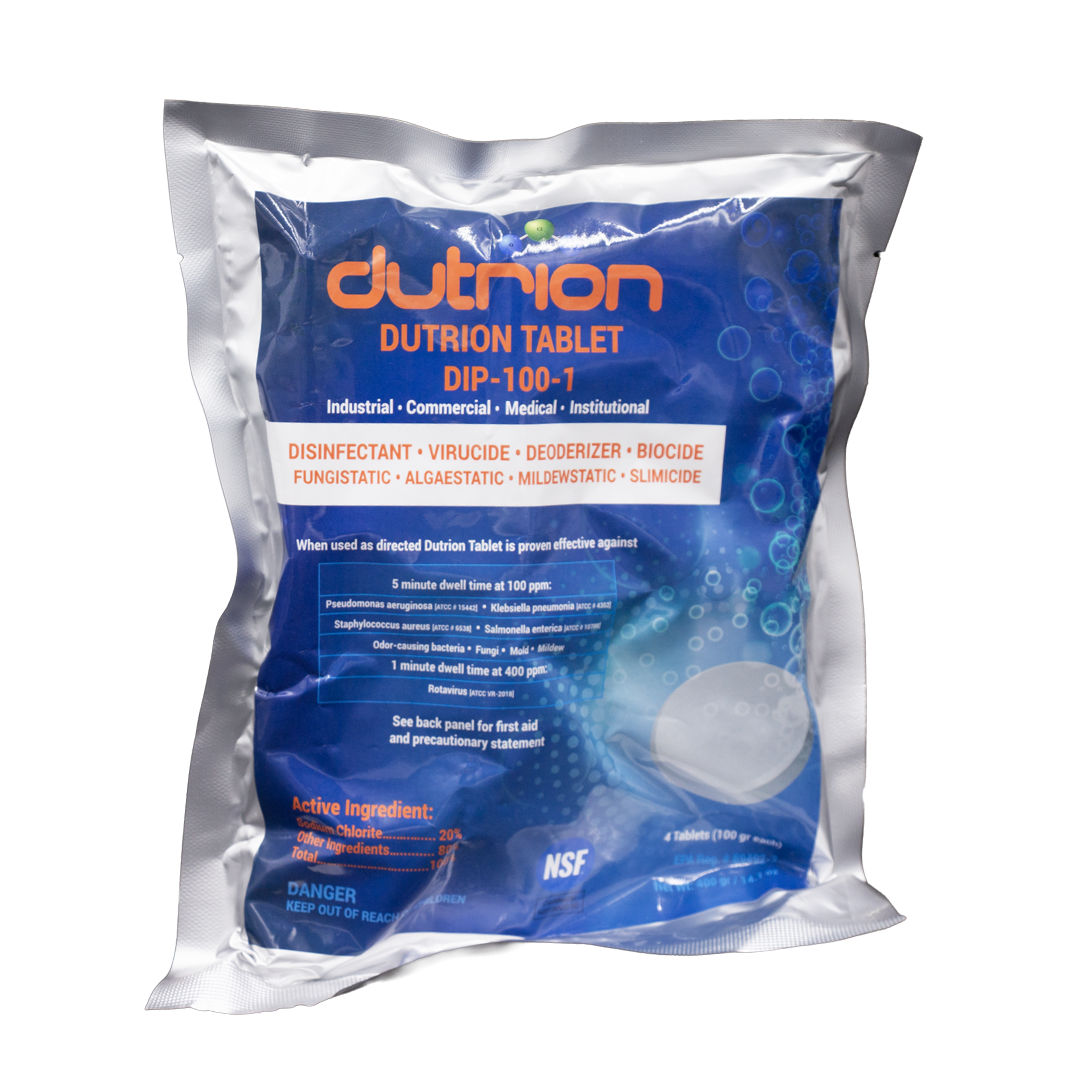
Drop a tablet in water, get a stable ClO₂ solution. Spray, wipe or pump onto hard, non-porous surfaces.
Reach for tablets when
You're disinfecting accessible surfaces and contents, building cleaning solution by the quart, gallon or pail, and need a residue-free finish you can stand behind on a clearance.
Shop Dutrion Tablets →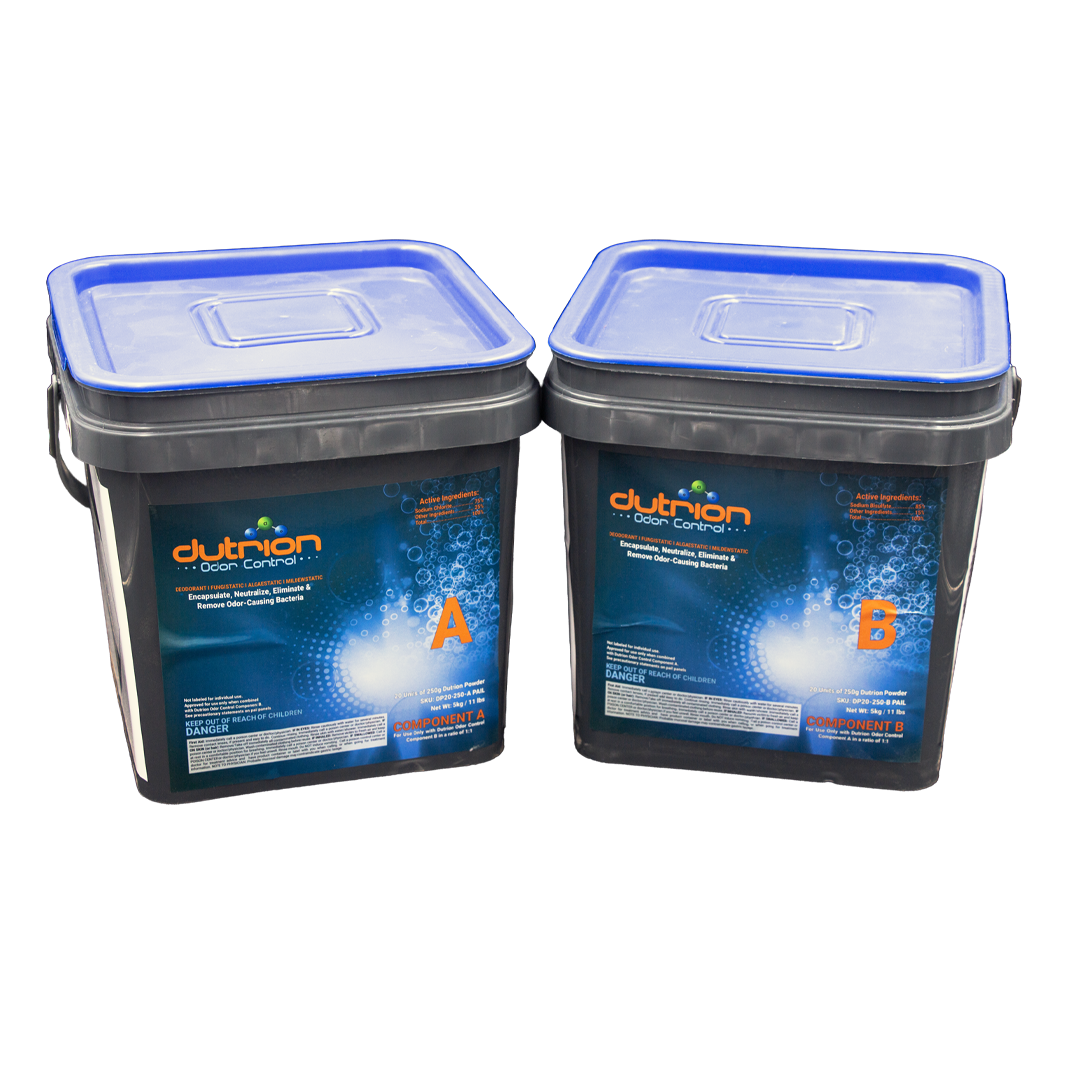
A two-part (Part A + B) concentrate that fills an entire space with ClO₂ vapor — reaching everything a liquid can't.
Reach for powder when
The contamination or odor is everywhere and out of reach — smoke through a structure, animal odor in cavities, a hoarding interior — and you need the gas to find it for you.
Shop Dutrion Powder Kits →Both Dutrion formats are EPA-registered pesticides. It is a violation of federal law to use either in a manner inconsistent with its labeling. Keep the product label on hand at the point of use, confirm the ppm and dwell time for the claim you're making, and follow the SDS — the EPA fumigation study describes the underlying chemistry, not a substitute for label directions.
Handle as an oxidizer. Mind fumes during mixing, ventilate the work area, wear appropriate PPE, and use a NIOSH/MSHA-approved respirator for chlorine dioxide when fogging or high-pressure spraying. Extended metal contact can discolor or pit; never combine with acids or other cleaners.