

Not All Fuels
Stink the Same Way
Why Every Fuel Odor Behaves Differently
Gasoline, diesel, motor oil, and heating oil are completely different chemistry problems. Treating them all the same is exactly why odor callbacks happen. Your nose is detecting different volatile compounds in each one, which means they move through structures differently and require different remediation strategies to eliminate them permanently.
Let’s Set the Scene
There is a very specific joy to walking into a garage mid-project. Someone’s finally pulling the engine on a car that’s been sitting for a decade. Old gasoline in the tank, motor oil baked into the concrete, the faint ghost of something that might be brake fluid from the previous owner. Honestly? It smells incredible. Not in a “this is pleasant” way, but more in a “I know exactly what is happening here and it makes sense to me” way. Garages are supposed to smell like garages.
Then Monday comes. The door’s been shut all weekend. Temperature dropped Saturday night, climbed back up Sunday afternoon. You walk past the interior door to the kitchen, and there it is. That sharp, low petroleum bite, hanging in the air somewhere between the refrigerator and the dining room. Windows don’t fix it. Candles make it worse. The garage smell found a new home, yours.
Scale that up to a commercial loss. A diesel spill in a mechanical room with a concrete slab that absorbed fuel for six hours before anyone caught it. A rental property where the tenant ran a small engine repair operation out of the attached garage for three years without mentioning it. A fire loss where fuel from the vehicle ignition point baked into every porous surface within twenty feet of the engine bay. In these scenarios, the smell isn’t an inconvenience — it’s a liability, a health concern, and a remediation job that most standard approaches will fail to resolve. Here’s why, and here’s what actually works.
Here’s the part most people skip: gasoline and diesel are not the same compound, and neither is motor oil. They have different molecular weights, different vapor pressures, different penetration depths, different odor thresholds, and they require meaningfully-different treatment emphases. If you’re walking into every petroleum odor job with the same game plan, you’re guessing — and the callbacks will prove it.
The Science of Petroleum Odor
BTEX, PAHs, Vapor Pressure, and Why Your Nose Is Barely Getting Started
The human olfactory system is, in some respects, an incredibly sensitive analytical instrument. In the context of petroleum odors, this is mostly unwelcome news. The compounds that make fuel and oil smell the way they do are detectable at concentrations that most air quality instruments struggle to measure. Understanding this is important because it recalibrates what “it smells fine now” actually means when you’re standing in a remediated space.
BTEX: Why Gasoline Odor Gets Everywhere Fast
BTEX stands for Benzene, Toluene, Ethylbenzene, and Xylene — a group of monoaromatic hydrocarbons that make up roughly 15–25% of typical gasoline by volume. They are small molecules with high vapor pressure, meaning they volatilize readily at ambient temperature and distribute through air quickly. They are also the primary contributors to the characteristic gasoline odor signature.
Benzene’s odor detection threshold is approximately 0.5 ppm. Toluene carries that sweet, sharp character and is detectable at around 1–2 ppm. These concentrations are below OSHA’s short-term exposure limits, which means you can be detecting a clear, definite petroleum odor in a space that technically reads as “safe” on an air monitor. This matters enormously for post-treatment verification: olfactory clearance is not the same as chemical clearance.
Once airborne, BTEX compounds follow a sorption equilibrium between the air phase and surrounding materials. Any porous surface — drywall paper, wood substrate, carpet backing, acoustic tile, duct liner insulation — serves as a reservoir. The equilibrium is dynamic and temperature-driven: as temperature rises, the partition shifts toward the gas phase and the reservoir off-gases back into the room. This is not residual contamination. It is the fundamental physics of how volatile organic compounds behave in a closed system.
“Naphthalene has an odor detection threshold of around 0.038 ppm. For reference, that’s 38 parts per billion. You are detecting a molecule that makes up an almost unmeasurably small fraction of the air you’re breathing.”
PAHs (Polycyclic Aromatic Hydrocarbons) are the defining chemistry of diesel, heating oil, and used motor oil jobs. Naphthalene is the simplest and most volatile PAH and is present in diesel at 1–5% by volume. It is a solid at room temperature — its melting point is 80°C — but it sublimates at ambient conditions, meaning it transitions directly from solid to vapor without becoming liquid first. This sublimation is slow and continuous, which is exactly why diesel-contaminated concrete off-gases long after the liquid fuel has been absorbed. The heavier PAHs (phenanthrene, anthracene, pyrene) have even lower vapor pressures and move even more slowly — but they also embed deeper and are significantly harder to oxidize.
0.038
ppm — Naphthalene
Odor detection threshold. Found in diesel at 1–5% by volume. Sublimates from concrete for years post-spill.
200+
Compounds in Gasoline
Individual hydrocarbon species identified in typical pump gasoline, each with its own volatility and odor character.
3–4 in.
Slab Penetration
Depth petroleum hydrocarbons can wick into untreated concrete matrix from a surface spill over 24–48 hours.
Know What You’re Dealing With
Gasoline, Diesel, Motor Oil:
Similar Smells, Completely Different Problems
Petroleum products are complex hydrocarbon mixtures — but “complex” is doing a lot of work in that sentence. Gasoline is predominantly C4–C12 hydrocarbons. Diesel runs C10–C22. Motor oil (when it’s fresh) is C20–C40 base stock. Used motor oil is a different beast entirely, mixed with combustion byproducts from every heat cycle it’s been through. These differences directly determine how the odor behaves in a structure, how deep it penetrates, and how long it persists.
| Fuel Type | Carbon Range | Vapor Pressure | Odor Persistence | Primary Odor Compounds |
|---|---|---|---|---|
| Gasoline High VOC | C4 – C12 | High (7–15 psi RVP) | Fast spread, moderate depth | BTEX aromatics, light alkanes |
| Diesel / Fuel Oil Deep Embed | C10 – C22 | Low (<0.5 psi) | Slower spread, extreme depth & persistence | Naphthalene, PAHs, mercaptans, heavier alkanes |
| Motor Oil (fresh) Low VOC | C20 – C40 | Negligible | Surface-heavy, slow off-gas | Heavy base stock aromatics, oxidation products |
| Used Motor Oil High VOC | C20–C40 + byproducts | Low–moderate | Long-term, acrid off-gassing from slab | Combustion VOCs, carbonyl compounds, sulfur species, PAHs |
| Heating Oil (No. 2) Deep Embed | C10 – C20 | Low (<0.5 psi) | Extremely persistent in concrete & soil | Nearly identical to diesel — naphthalene, PAHs, alkylbenzenes |
ⓘ Field Note
Why diesel jobs are harder than gasoline jobs — even though diesel “smells less”
Here’s a counterintuitive one: gasoline smells stronger and feels more aggressive, but diesel jobs are typically harder to resolve. Because gasoline has high vapor pressure, its lightest fractions volatilize quickly — which means they also leave the substrate faster during ventilation and treatment. The BTEX fraction (Benzene, Toluene, Ethylbenzene, & Xylene VOC's naturally occurring in petroleum derivatives) is highly reactive with ClO₂ and responds well to oxidative treatment.
Diesel, on the other hand, has low vapor pressure. The heavier compounds move slowly into the substrate and move slowly back out. Naphthalene (detectable at around 0.038 ppm by smell — a remarkably low threshold) is a semi-volatile solid at room temperature that sublimates slowly into the air, soaking progressively deeper into concrete over time and makes up a significant portion of the aromatic compounds in diesel. A diesel spill left on a concrete slab for 48 hours has penetrated further into the matrix than a comparable gasoline spill would. And it will continue off-gassing from that depth for years — not weeks.
The practical implication: a diesel job that passes olfactory clearance in cool, low-humidity conditions may fail dramatically on a 90°F August afternoon when vapor pressure rises and sublimation accelerates. Temperature-corrected verification and VaporLock encapsulation are non-negotiable on any diesel or heating oil job.
Used motor oil deserves its own mention because it is chemically very different from fresh oil, and contractors sometimes underestimate it. Every heat cycle that motor oil goes through oxidizes the base stock, producing carbonyl compounds (aldehydes, ketones), and exposes the oil to combustion blow-by gases — loading it with PAHs, aromatic nitrogen compounds, and sulfur species. The smell of used oil baked into a garage slab is a combination of heavy base stock, combustion chemistry, and oxidative degradation products. It is persistent, acrid, and, because the base stock has had its viscosity and surface tension altered by oxidation, it penetrates concrete more aggressively than fresh oil does.
The Persistence Mechanism
Concrete Is Not a Floor. It’s a Reservoir.
This reframe matters. Concrete is a porous, high-surface-area material with a complex internal structure of capillary pores, gel pores, and air voids. When petroleum contacts an uncoated concrete slab, capillary action pulls the liquid phase down into the slab profile while the volatile fraction simultaneously begins partitioning into the air column above. Both processes happen at once, and the rate depends on the compound’s viscosity, the concrete’s porosity (which varies significantly by mix design and age), and temperature.
For gasoline, the penetration is primarily capillary-driven but relatively shallow due to the high volatility of the light fractions — much of the lightest material volatilizes before it can penetrate deep. For diesel, the heavier molecular weight and lower vapor pressure means more of the compound mass wicks deeper into the slab before volatilizing. For motor oil, particularly used oil, the altered viscosity from thermal cycling can actually increase concrete penetration compared to fresh oil of the same base stock.
This is why surface-level treatments — degreasing, pressure washing, even aggressive scrubbing — consistently underperform on aged spills. By the time you’re treating the surface, the contamination has already stratified into layers: a heavier concentration near the surface that extractable methods can reach, and a lower-concentration but chemically stable zone embedded deeper in the slab profile. The poultice method is specifically designed to address this stratification — drawing compounds out of the pore structure by capillary reversal rather than trying to push emulsifiers down into it. More on that in the protocol section.
The Thermal Cycling Problem — And Why You Keep Getting Called Back in August
A petroleum odor job that clears in March will come back in July. If you’ve been in this industry for more than two summers, you’ve seen this. Here’s the exact mechanism: vapor pressure is exponentially temperature-dependent. A compound embedded in a concrete slab at 55°F has a vapor pressure — and therefore an off-gassing rate — that can be three to five times lower than the same compound at 85°F. The math means that a treatment outcome verified in cool conditions may not hold when the slab thermally cycles to summer temperatures.
This isn’t a treatment failure in the strict sense. The chemistry that was done in March was real. The issue is that the treatment addressed the current equilibrium condition, not the conditions the substrate will experience in July. Residual compounds embedded at depth, below the zone effectively reached by surface treatment and fumigation, off-gas at accelerating rates as temperature climbs. The only way to break this cycle is to physically close the vapor emission pathway at the substrate surface — not to try to neutralize every molecule embedded three inches deep in a concrete slab. That’s what encapsulation does, and it’s why it’s not optional on diesel, heating oil, or high-load motor oil jobs.
There’s also a humidity component: as relative humidity decreases (typical of summer air conditioning), the moisture content of concrete drops, and the effective surface area available for petroleum compound adsorption decreases, which pushes more of the compound inventory into the gas phase. Hot, dry summer conditions are the worst-case scenario for a partially treated petroleum odor job.
Common Failure Points
Why These Jobs Come Back — Every Time
Petroleum odor callbacks aren’t bad luck. They’re predictable outcomes from specific gaps. Here’s what to actually look for.
- Degreasing the surface and calling it done. Pressure washing and a commercial degreaser will remove the surface-accessible fraction of petroleum contamination. They do nothing about the compound inventory embedded one to three inches into the slab profile. The reservoir is untouched. Capillary re-migration repopulates the surface within days, and the odor is back within weeks. This is the single most common failure mode on residential garage jobs.
- Skipping the poultice step on older stains. On fresh spills, emulsification and extraction at the surface may be sufficient for Step 1. On aged contamination — anything with more than a few days of dwell time in the slab — the pore-bound fraction has partially cured and is no longer responsive to surface-applied emulsifiers alone. A poultice draws that bound material back out via capillary reversal; skipping it leaves a significant portion of the contamination inventory intact and guarantees partial treatment.
- Treating gasoline like diesel. They respond differently. Gasoline BTEX is highly reactive with ClO₂ and responds aggressively to fumigation. Diesel PAHs are heavier, less reactive, and embedded deeper. A fumigation protocol adequate for gasoline may under-treat a comparable diesel contamination volume. Know which fuel you’re dealing with before you scope the treatment.
- Missing the HVAC system. Return air draws from floor-level registers and any garage-adjacent space, pulling petroleum VOCs into the air handler and distributing them throughout the conditioned structure. Duct liner, coil insulation, and filter housing accumulate compound loading over time. If the HVAC has been operating in a petroleum-contaminated space, the ductwork is a secondary emission source that will undermine any treatment limited to the source area.
- Skipping encapsulation on diesel and motor oil jobs. VaporLock on a gasoline-only job with a short spill history is sometimes optional. VaporLock on any diesel, heating oil, or long-term motor oil accumulation job is not. The substrate reservoir is too deep and too chemically resistant for fumigation alone to eliminate the full inventory. Without a vapor barrier closing the emission pathway, the thermal cycling mechanism will produce odor return — the only question is whether it’s this summer or next summer.
- Olfactory verification in cool conditions. Clearing a space by smell in March and handing it back to the client is not verification — it’s a setup for a July callback. If you can’t do post-treatment PID readings across a range of temperature conditions, at minimum document the temperature-dependent nature of the clearance and communicate explicitly to the client that VaporLock was or was not applied and why that matters for long-term odor stability.
Professional Protocol
The System: Break It Down, Oxidize It, Seal It In
Three steps. Non-negotiable order. Each one makes the next one more effective — and cutting any of them produces a predictably incomplete outcome. The sequence is built around the actual chemistry of petroleum odor in building materials, not around what’s most convenient on a job site.
Fuel Odor Remediation — Three-Step Protocol
Emulsify the residue. Oxidize the vapor. Seal the pathway.
Step 1
Emulsify & Extract
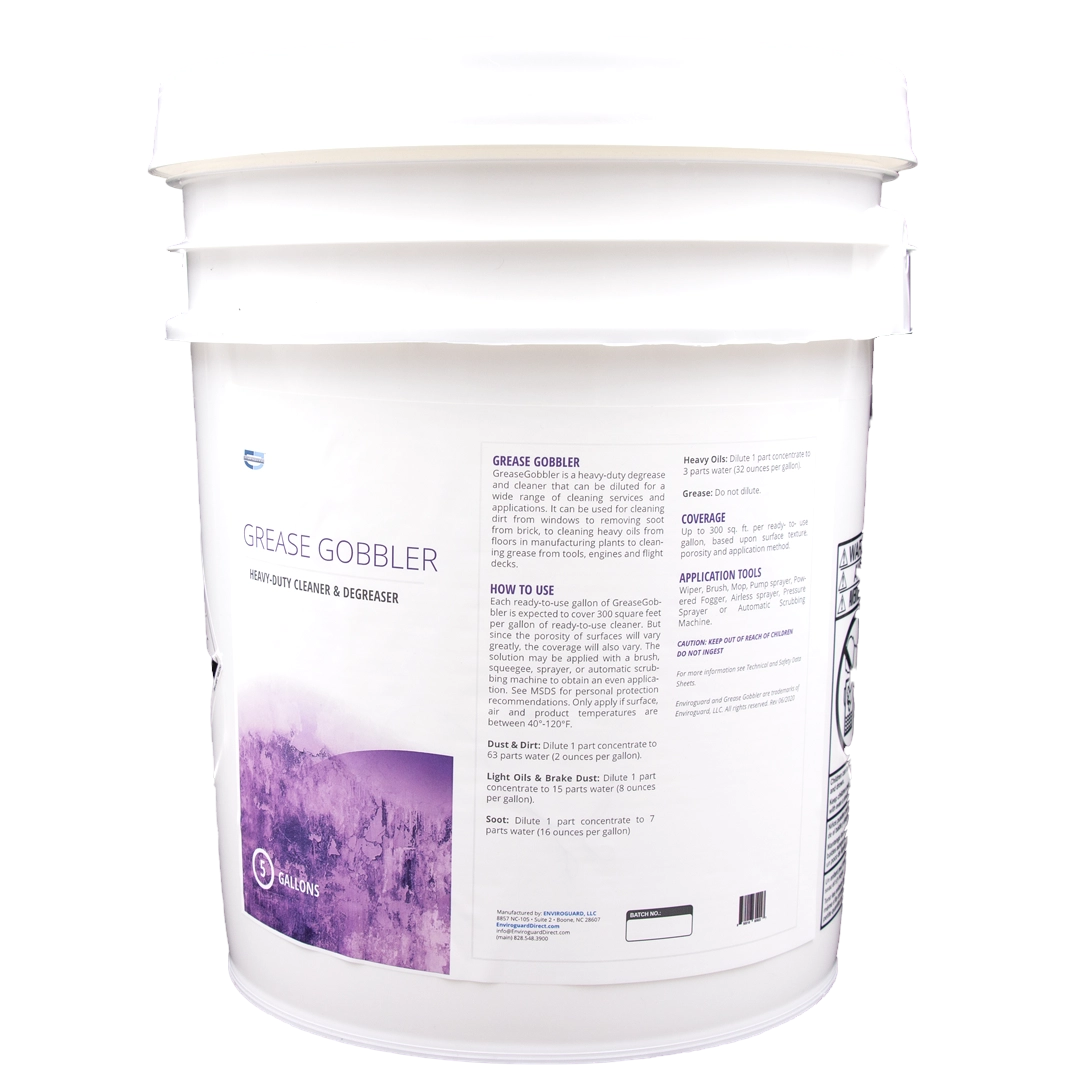
Grease Gobbler
Step 2
Oxidize VOCs
Dutrion Wet & Dry
Step 3
Vapor Barrier
VaporLock
Emulsify, Poultice, and Extract the Petroleum Residue — Grease Gobbler
Grease Gobbler
You cannot oxidize what is locked inside a greasy film. Step one is not glamorous, but it is load-bearing: Grease Gobbler penetrates the concrete surface and emulsifies the petroleum residue — breaking the hydrocarbon’s bond with the substrate matrix and converting it from a surface-bound film into a water-miscible phase that can be extracted and removed. The distinction from basic pressure washing is that the emulsification chemistry reaches below the visible surface stain, into the capillary pore structure where the actual contamination inventory lives.
Apply across the full affected zone, not just the visible stain footprint. Petroleum compounds wick and migrate well beyond the visible contamination boundary, so the treatment perimeter should be defined by the contamination extent, not by what you can see.
The Poultice Method — For Aged, Set-In, or High-Concentration Stains
On fresh spills, a standard emulsification-and-extraction pass does most of the work. On aged contamination — anything that has had more than a few days to cure into the concrete matrix — emulsification alone may not fully release the pore-bound fraction. This is where the poultice method becomes essential.
A poultice works by capillary reversal: an absorbent carrier material, saturated with a solvent or emulsifying agent, is applied to the contaminated surface as a thick paste and sealed in place with plastic sheeting. As the poultice dries slowly under the seal, the capillary gradient reverses — the paste draws hydrocarbons out of the concrete pores and into the carrier material rather than pushing new chemistry down into them. The result is physical extraction of contamination that would otherwise remain locked in the slab even after aggressive surface scrubbing.
How to Execute It
- Mix an absorbent carrier (diatomaceous earth, powdered chalk/whiting, or a commercial absorbent powder) with Grease Gobbler at a ratio that produces a thick, peanut-butter-consistency paste. The carrier needs enough surface area and absorption capacity to hold the extracted petroleum compounds; too wet and capillary action is lost.
- Apply the paste 1/4 to 1/2 inch thick over the full stained zone, extending 3–4 inches beyond the visible stain boundary.
- Cover immediately with plastic sheeting and tape edges to slow evaporation. This is critical — the dwell time chemistry only works if the poultice stays moist long enough to maintain the capillary gradient. On low-humidity days or warm slabs, tape all four sides.
- Allow to dwell for a minimum of 12–24 hours. On heavy diesel or long-term motor oil contamination, a 24–48 hour dwell is standard. The poultice should be visibly darkened with extracted petroleum when you remove it.
- Remove the dried poultice, bag and dispose of it as petroleum-contaminated waste, then extract the residue with hot water rinse. A second poultice application is standard practice on any slab with multi-year contamination history — the first pass pulls the accessible pore fraction; the second targets the deeper reservoir.
The poultice method is most impactful on: garage floors with decade-scale motor oil accumulation, concrete with visible ring patterns indicating repeated spills over time, any slab where prior pressure washing attempts have visibly reduced but not eliminated staining, and diesel jobs where the spill had significant dwell time before remediation began.
On a fresh, low-volume gasoline spill on an otherwise clean slab, straight Grease Gobbler application and extraction is sufficient. On anything else, plan the poultice step into your scope.
On diesel and heating oil jobs specifically, warm the application slightly if ambient temperature is low — both emulsification chemistry and capillary extraction work faster and more effectively at warmer temperatures, which matters on heavy PAH jobs where the compounds are already moving slowly.
Shop Grease Gobbler ›Oxidize the Full VOC Inventory — Dutrion Wet & Dry
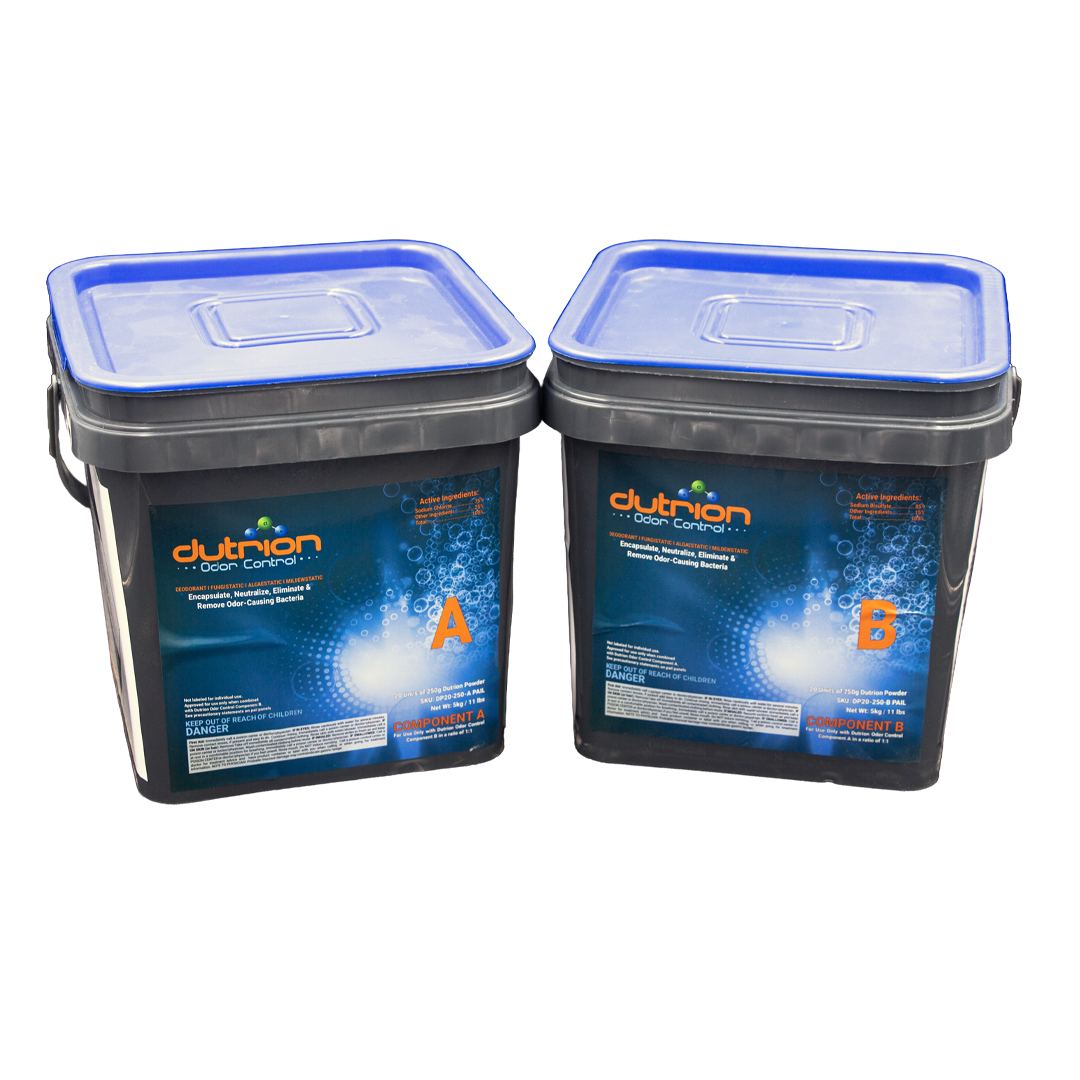
Dutrion Wet & Dry
After surface extraction, the volatile compound inventory remains distributed across three zones: the air column, the HVAC system, and the porous substrate materials beyond the liquid treatment reach. Dutrion’s chlorine dioxide (ClO₂) addresses all three simultaneously — but the gas phase fumigation is where it does its most important work on petroleum odor jobs.
ClO₂ is a radical oxidizer. It reacts with petroleum compounds through a mechanism that cleaves aromatic rings and oxidizes alkyl side chains, converting odor-generating hydrocarbons into non-odorous oxygen-containing end products. For BTEX aromatics, this reaction is fast and highly effective. For heavier PAHs in diesel jobs, the reaction is still effective but requires adequate concentration and dwell time — PAHs are more chemically stable than light aromatics, and an under-dosed fumigation that clears the BTEX fraction but leaves the naphthalene partially treated is a predictable callback generator.
The gas phase matters especially here: ClO₂ vapor penetrates HVAC ductwork, wall cavities adjacent to garages, subfloor voids, and every other confined space where petroleum vapors accumulate but liquid application cannot reach. One correctly dosed gas-phase fumigation treats the entire volumetric odor load in a structure in a way that surface liquid treatment simply cannot.
Shop Dutrion ›Close the Re-Emission Pathway — VaporLock
VaporLock
Steps one and two eliminate what they can reach. VaporLock handles the rest — not by eliminating it, but by making it irrelevant. Applied to treated concrete, OSB, drywall, and any structural surface with confirmed petroleum loading, VaporLock forms a vapor-impermeable encapsulant barrier that physically blocks residual hydrocarbons embedded below the treated zone from migrating back into the occupied airspace. Whatever remains below the barrier stays below the barrier, regardless of temperature.
This is the step that transforms a seasonally-dependent result into a durable one. Without it, you have treated the contamination load that was accessible at the time of the job, and left an open pathway for the reservoir at depth to continue off-gassing every time conditions drive equilibrium toward the vapor phase. With it, you have closed that pathway permanently.
Mandatory on: diesel jobs (any significant volume), heating oil spills, garage slabs with multiple years of motor oil accumulation, any petroleum fire loss involving structural materials, and subfloor assemblies above contaminated crawl spaces. On a short-history, low-volume gasoline-only job with confirmed shallow penetration, it may be appropriate to recommend but not necessarily mandatory. On anything heavier or longer-duration, it is not optional — it is the difference between a job that holds and a job that comes back.
Shop VaporLock ›The Takeaway

The Garage Smell Is Chemistry. Treat It Like Chemistry.
Gasoline, diesel, motor oil, and heating oil smell different because they are different — different molecular weights, different vapor pressures, different penetration depths, different reactivity with oxidizers. Treating them identically produces inconsistent results and a predictable pattern of seasonal callbacks.
The things that don’t work — pressure washing, ventilation, fragrance masking, painting over it — have one thing in common: they operate at the surface of the problem while the actual contamination inventory lives below the surface, in the concrete matrix, in the substrate, embedded in pore structure that a hose and a bucket of cleaner were never going to reach.
The protocol that works addresses the problem at three levels in the right order: emulsify and poultice-extract the accessible residue (including the pore-bound fraction that standard scrubbing misses on aged stains), oxidize the volatile compound inventory distributed throughout the space, and seal the re-emission pathway in the substrate so the job holds through every summer heat cycle that follows. That’s not a product pitch. That’s the chemistry of petroleum odor, and the protocol follows directly from it.
The garage can smell like a garage. The house next door doesn’t have to.
Become an Enviroguard Certified Firm
Get the product stack, the OSI training, Assessment Guide, and the SOP your crews need to stop eating callbacks on fire loss work plus placement in our Find a Pro directory.
Apply to Become a Certified Firm